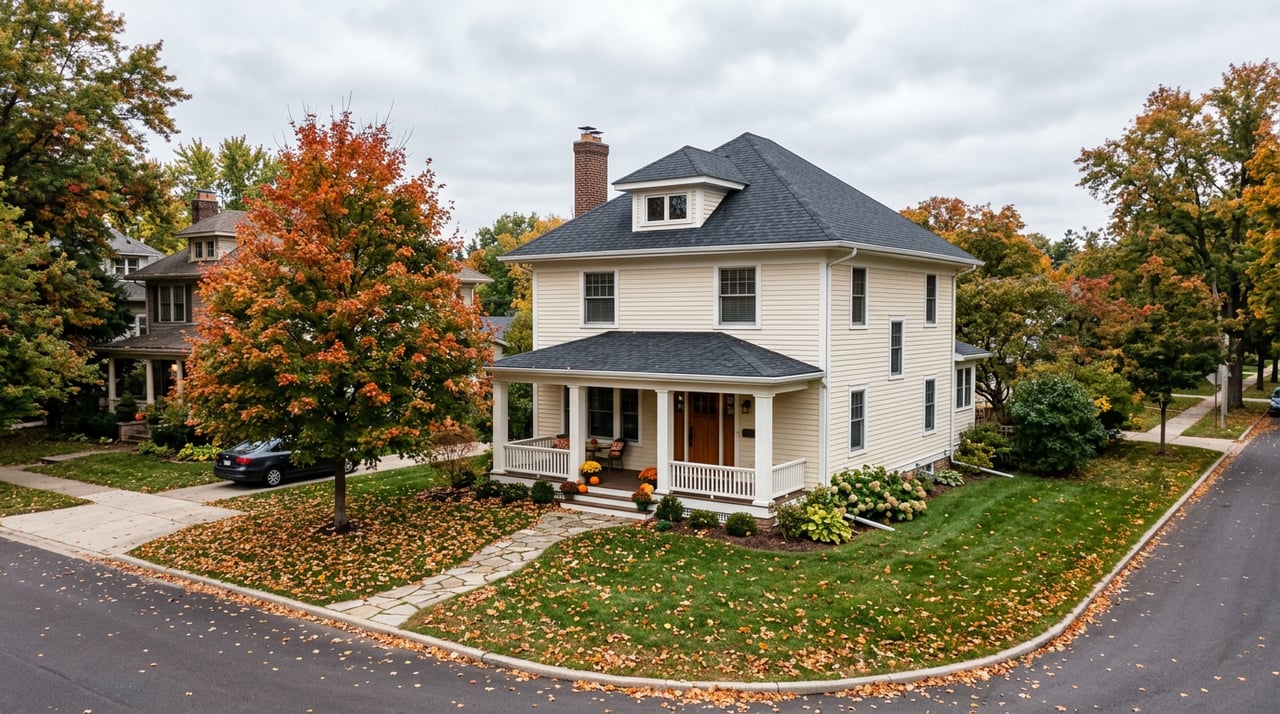
East Isles Minneapolis Fall: A Calendar Shared With Neighbors
September 24, 2026
September 24, 2026
Walk the perimeter of Lake of the Isles this week and you'll notice the Thursday crowd at Lagoon and Girard thinning out. The Uptown Farmers Market runs its last Thursday of the season on September 24, the same week most East Isles residents start swapping the lake loop for sweaters. It feels like the neighborhood's clock running down for the year.
The market sits outside the neighborhood's own boundary lines, and understanding why tells you something true about how this particular pocket of Minneapolis actually functions: East Isles has almost no commercial footprint of its own, and its social calendar is largely borrowed.
The East Isles Neighborhood Association draws its own boundary plainly: West 22nd Street to the north, West Lake Street to the south, Hennepin Avenue to the east, and the lakeshores to the west. Inside that rectangle, the neighborhood's own business directory is short. It lists a Chipotle, a construction firm called Ironmark Building Co., a private events and catering space known as The Lynhall No. 2640, Bogart's Doughnut Co., and two churches, St. Mary's Greek Orthodox Church and St. Paul's Episcopal Church on Lake of the Isles.
That's close to the entire commercial roster for a neighborhood wrapped around one of the city's most photographed lakes. Compare that to Lowry Hill East or Whittier, where the retail strip is the neighborhood's identity. East Isles reads more like a residential ring, its retail life pushed to the edges where Hennepin Avenue does the heavy lifting for restaurants and shops that technically belong to Uptown's commercial corridor rather than to East Isles itself.
This matters if you've ever wondered why East Isles never shows up on its own in local "where to eat" roundups. The neighborhood isn't quiet because nothing happens near it. It's quiet because almost nothing commercial happens inside the four streets that define it. Everything else is a short walk into somebody else's boundary.
That Thursday farmers market at Lagoon and Girard is billed jointly, and the East Isles Neighborhood Association's own event listing spells out the shared ownership: it serves East Isles, Lowry Hill, East Bde Maka Ska, Kenwood, Cedar-Isles-Dean, and The Wedge all at once. Six neighborhoods, one market, running Thursdays from 4 to 8 p.m. from June 11 through September 24, 2026.
That's not a criticism of the market. It's a useful fact about East Isles' place in the larger Uptown ecosystem. When residents here talk about "our" farmers market, "our" summer patio scene, or "our" ice cream stop, they're almost always describing something that belongs jointly to a cluster of neighborhoods, not to East Isles alone. The lake itself, meanwhile, is entirely East Isles' western edge and nobody else's, which is part of why the loop around it feels like the one thing residents can point to and call unambiguously theirs.
Once the market ends this Thursday, there is a real gap. Nothing steps in to replace that specific Thursday rhythm until the calendar turns over next June. The neighborhood doesn't fill that hole with a competing event. It just goes quiet on Thursdays for a few months, which is a different kind of fall transition than a neighborhood with its own commercial strip would experience.
If the farmers market is borrowed, the one event on the fall calendar that's genuinely co-owned by East Isles is the October cleanup. On Saturday, October 10, from 1 to 3 p.m., East Isles and Wedge neighbors are gathering for a walk described plainly in the neighborhood's own listing: they'll head west toward the dog park and east toward Lyndale, picking up litter as they go.
Notice the geography again. Even the neighborhood's own signature fall event routes participants out of East Isles' boundary and into Wedge territory to the east. There's no way to do this walk and stay inside the four streets that define East Isles. The cleanup is a genuine local tradition, but it's also a small proof point for the larger pattern: almost everything East Isles residents do together this time of year happens partly on somebody else's block.
Here's how the two anchor events of the season line up against each other:
| Event | Date | Hosted By | Stays Inside East Isles? |
|---|---|---|---|
| Uptown Farmers Market | Thursdays through Sept. 24, 2026 | Six-neighborhood coalition including East Isles | No, held at Lagoon & Girard |
| Fall Cleanup Walk | Sat., Oct. 10, 2026, 1-3 p.m. | East Isles and Wedge neighbors | Partially, route crosses into Wedge |
Between those two dates sits a real lull, roughly two weeks where the neighborhood has no organized reason to gather outdoors before the cleanup fills the gap in October.
None of this means East Isles goes dark once the market ends. The six entries in its own business directory are small in number but specific in what they offer, and each one says something about how this neighborhood actually operates day to day.
These six names are what East Isles has instead of a commercial strip. They're not competing for foot traffic the way a restaurant row would. They're the fixed points residents return to precisely because there isn't a rotating cast of new openings to track.
The lake itself doesn't follow the same calendar as the market or the cleanup. Lake of the Isles carries 2.63 miles of pedestrian trail and 2.76 miles of bike trail encircling the water, plus two canoe and kayak storage racks on the northwest and south shores that most residents will be emptying out as the season turns. The lake is an engineered one, dredged from a shallow marsh in the early 20th century by the Minneapolis Park and Recreation Board, and it's been under some form of shoreline stabilization and path work since a renovation project began in 2001 following flood and windstorm damage from the late 1990s. None of that is finished business exactly, but it's also not new construction disrupting anyone's fall walk this year.
What changes with the season is simpler than any of that history. The Thursday habit built around the farmers market disappears for a few months. The one event that reliably fills a fall Saturday routes half its participants outside the neighborhood's own boundary. And the six entries in East Isles' own directory—Chipotle, the doughnut shop, the event space, the builder, and the two churches—become the closest thing the neighborhood has to a Main Street until next June brings the market back to Lagoon and Girard.
If you live inside those four streets, you already know this rhythm without needing it explained. If you're weighing whether a neighborhood built this way, quiet by design, borrowed in its calendar, but singular in its lake access, fits how you actually want to live, that's a longer conversation, and one Erin Sjöquist has walked with plenty of buyers who wanted lake access more than a commercial strip.
Curious what a home near this stretch of Lake of the Isles is actually worth in today's market? Get Your Instant Home Valuation or reach out to Erin Sjöquist directly to talk through what East Isles offers beyond its business directory.
November 5, 2026
October 22, 2026
October 8, 2026
September 24, 2026

September 10, 2026

August 27, 2026
August 13, 2026
August 6, 2026
July 16, 2026
Real estate isn’t just about properties — it’s about people, goals, and dreams. I approach every transaction with heart, strategy, and a commitment to achieving the best possible outcome for my clients. Whether you’re navigating a life change or seizing an investment opportunity, I’m here to make it simple, seamless, and successful.
GET IN TOUCH WITH ERIN

ERIN SJÖQUIST
1350 Lagoon Ave Ste 900 Minneapolis MN 55408